
Nano Carbon Tracer became the highlight of this event. Supporting UNDIP’s Energy Resilience. UNDIP, Aceh Tamiang (22/11) – Efforts to maintain oil production from old fields received support from the academic world. A research team from Universitas Diponegoro (UNDIP) Semarang, together with PT Pertamina EP Rantau Field, conducted well fluid sampling. In Rantau Field, Aceh Tamiang Regency, Aceh, on 17 – 20 November 2026. The samples served as test materials in research developing tracer and waterflooding technologies using nano carbon material.
Nano Carbon Tracer
Supporting UNDIP’s Energy Resilience
The UNDIP team was led by Professor of Material Physics in the Department of Physics, Faculty of Science and Mathematics (FSM) UNDIP, Prof. Dr. Agus Subagio, S.Si., M.Si. Samples were taken from two wells, namely Well A (P-419) and Well C, each in the form of crude oil (native oil), formation water, and injection water. A total of six samples were collected.
Challenges of Old Fields
About Nano Carbon Tracer
Energy resilience has become one of the government’s priority agendas. In 2026, the government is targeting oil lifting of 610 thousand barrels per day, up from the 2025 realization of 605.3 thousand barrels per day. The challenge is that most oil and gas fields in Indonesia are old with high water content, so their production continues to decline. The government is therefore encouraging the application of technologies such as enhanced oil recovery (EOR) in existing wells.
Information on Supporting UNDIP’s Energy Resilience
In old fields such as Rantau, which has been operating since 1928, waterflooding or water injection has become one of the main methods for maintaining reservoir pressure and pushing remaining oil so it can be produced. However, injected water does not always move evenly. Water can flow through shortcut paths in the reservoir, leaving much oil behind and not being pushed along.
“Energy resilience is not only about finding new fields, but also about how to maximize existing fields. That is where campus research can contribute, namely by bringing in technology that makes waterflooding more targeted and effective,” said Prof Agus.
Nano Carbon as a Tracer and Waterflooding Fluid
In this research, the UNDIP team is developing nano carbon, a carbon material measuring several nanometers that can fluoresce when illuminated. This material is designed for two functions. First, as a tracer or marker mixed into injection water. By detecting nano carbon fluorescence in production wells, operators can determine the direction and speed of injection water flow, while also identifying shortcut paths in the reservoir.
Nano carbon developed by the team can fluoresce in different colors, from blue to red, making it possible to mark several injection wells simultaneously. This material is also non-radioactive and can be detected at very low concentrations.
Second, nano carbon is being studied as a nanofluid in waterflooding, meaning it is mixed into injection water to help release oil stuck in rock pores so it can be more easily pushed toward production wells.
“With a tracer, we can ‘see’ where injection water flows underground. This information is very important for operators to adjust injection patterns so more oil is pushed,” said Prof Agus.
Why Native Fluids Are Needed
Information on Supporting UNDIP’s Energy Resilience
To be applicable, nano carbon must remain stable and its fluorescence readable when mixed with formation water and injection water containing salts and various ions. The natural fluorescence of oil and water from the field also needs to be measured so that tracer signals can be clearly distinguished. According to Prof Agus, fluid characteristics in each field differ, so samples from Rantau are key to ensuring the material being developed matches field conditions.
From Meeting Room to Wellhead
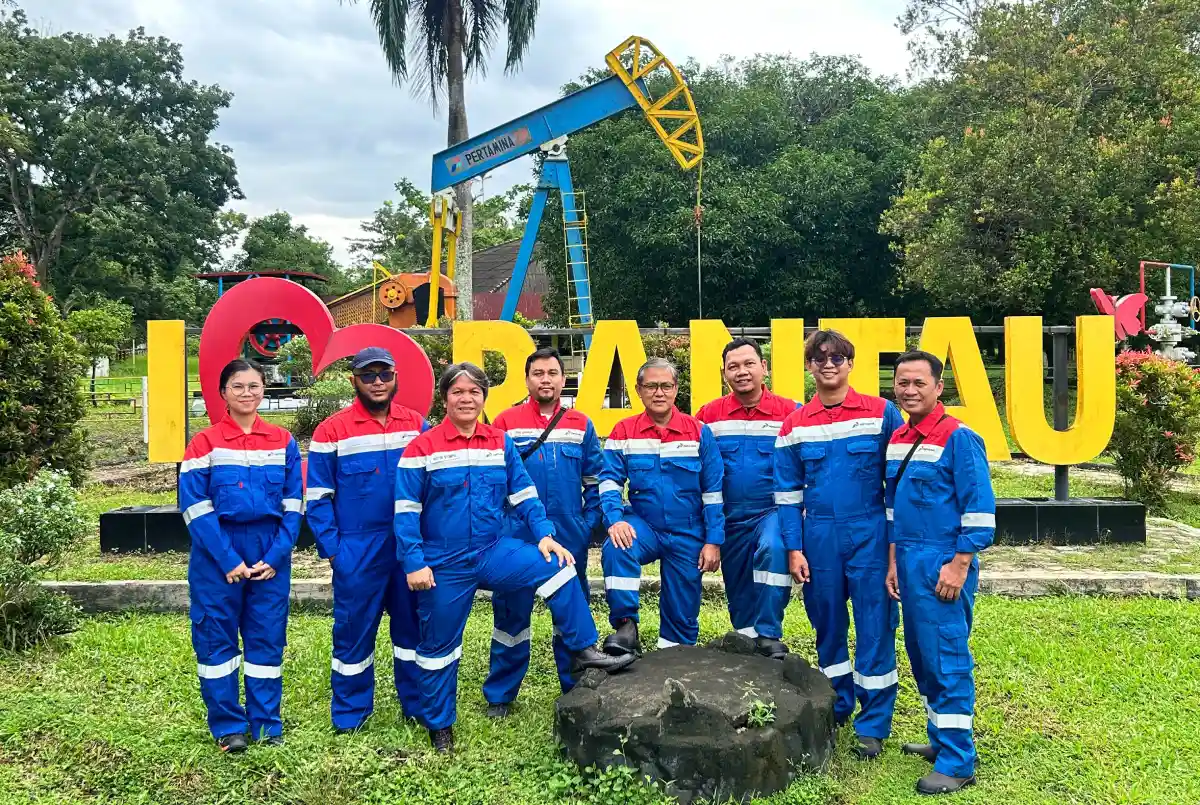
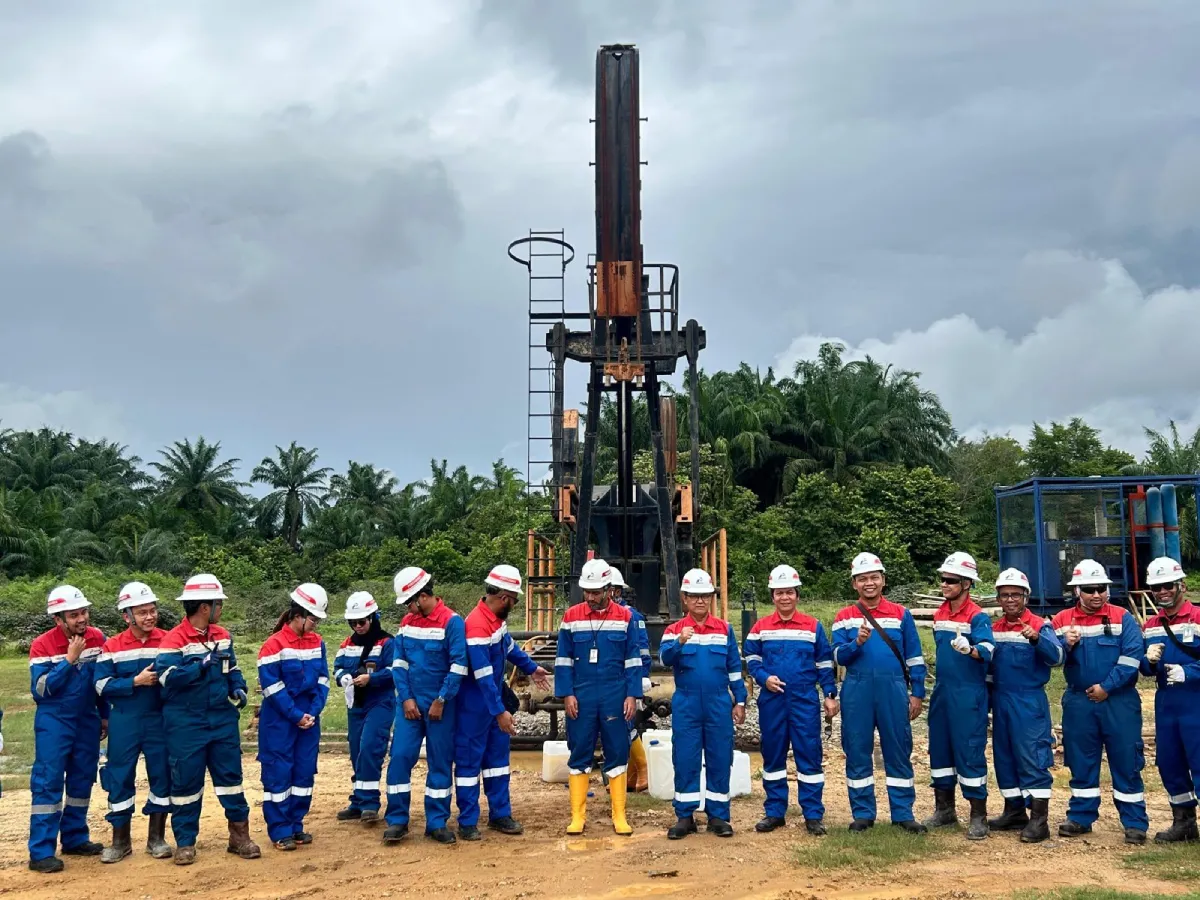
The activity began with a coordination meeting between the UNDIP team and the Pertamina EP Rantau Field team to discuss activity plans and developments in nano carbon research.
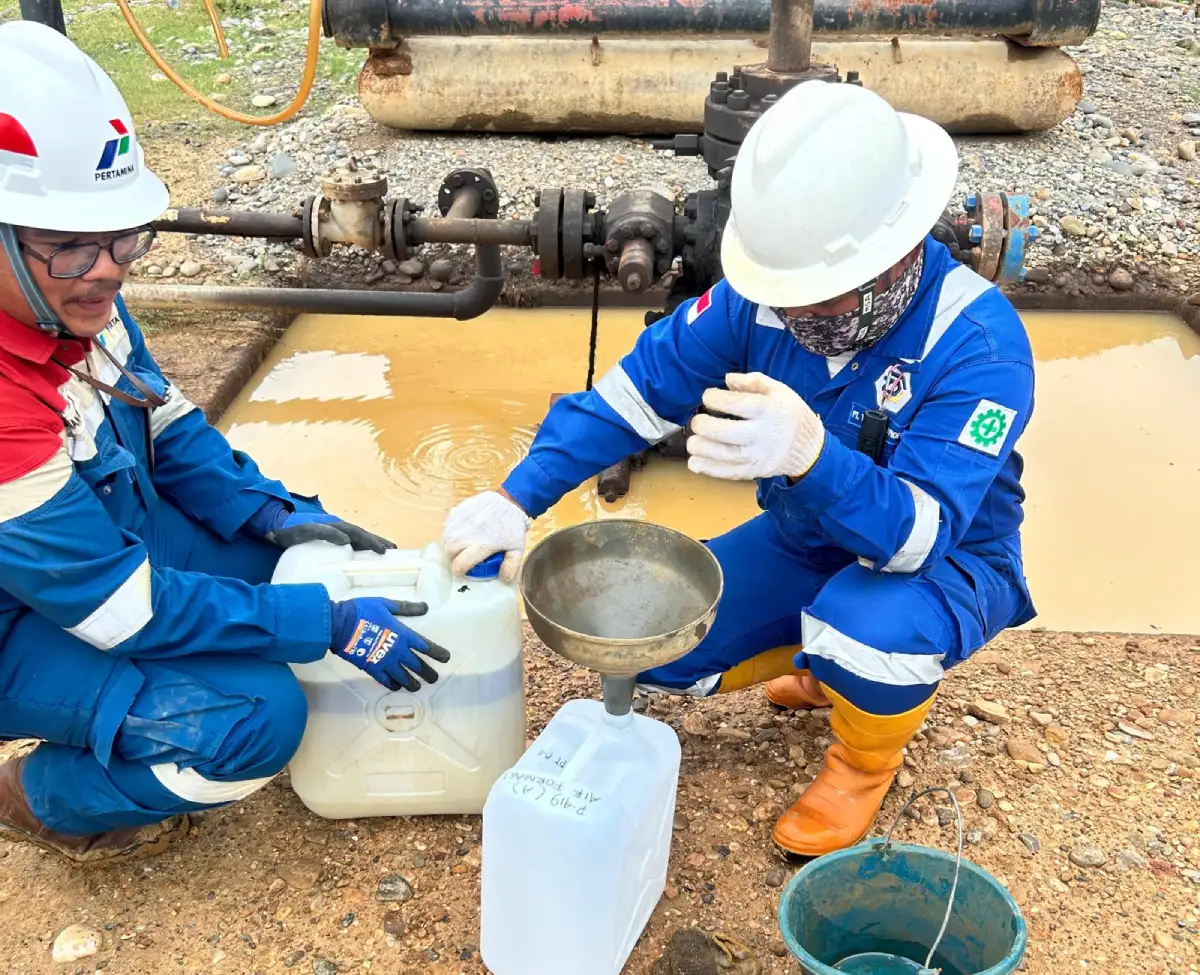
After an occupational safety briefing, the team along with Pertamina field personnel headed to the well location. Oil and formation water samples were taken from the wellhead (wellhead), then transferred to jerry cans using a funnel, while injection water samples were taken from the water injection line.
Each jerry can was immediately sealed tightly and labeled with the well number and sample type. The samples were handed over to UNDIP on 20 November 2026 to be brought to Semarang. In the laboratory, the samples will be analyzed for their physical and chemical properties, then used to test the stability and fluorescence of nano carbon in formation water and injection water, as well as its performance in laboratory-scale waterflooding tests.
Campus Commitment to Industry
Thus, this collaboration is a manifestation of UNDIP’s commitment to bring campus research closer to industry’s real needs. According to Prof Agus, universities should not stop at scientific publications, but also need to present solutions that can be utilized by industry and society.
Information on Supporting UNDIP’s Energy Resilience
“Universities have research resources, industry has real problems and field access. If the two meet, research results can be applied more quickly,” said Prof Agus. He added that collaborative research with industry also serves as a means to prepare human resources who understand the real challenges in the energy sector.
Laboratory analysis results will be submitted to Pertamina EP Rantau Field as material for joint study. If the results are promising, this tracer and waterflooding technology based on nano carbon has the potential to be developed to the field test stage. Prof Agus also thanked the management and personnel of Pertamina EP Rantau Field for their support. “We hope this cooperation continues and is beneficial for increasing national oil production,” he said. (Public Communications / UNDIP)
Baca juga: berita lainnya dari Magister Hukum UNDIP.
News source: undip.ac.id (Original: Dukung Ketahanan Energi, UNDIP dan Pertamina EP Rantau Field Kembangkan Tracer dan Waterflooding Berbasis Nano Carbon)