UNDIP Election Seminar 2025
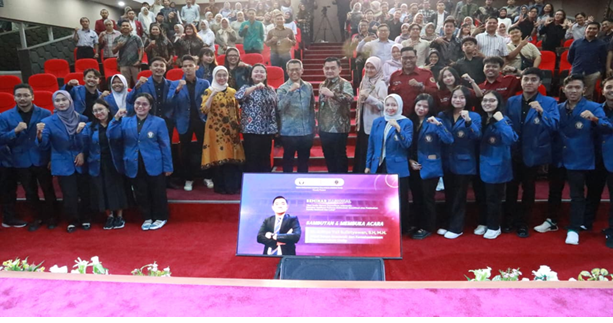
The UNDIP Election Seminar 2025 was organized by the Master of Law Program at the Faculty of Law, Universitas Diponegoro (UNDIP), in collaboration with the Association of Master of Law Students (IMMIH). Held on October 23, 2025, the event took place in a hybrid format at the Fiat Justitia Room, third floor of the Samiadji Soerjotjaroko, S.H. Building, UNDIP Faculty of Law campus in Tembalang, Semarang.
The seminar carried the theme “Quo Vadis Indonesia’s Electoral System: Assessing the Implications of the Constitutional Court Ruling on the Separation of National and Local Elections.” The event also featured the inauguration of the IMMIH board for the 2025–2026 term.
Dr. Aditya Yuli Sulistyawan, S.H., M.H., Vice Dean for Academic Affairs and Student Affairs at the Faculty of Law, officially opened the event. Participants included students from the 2025 cohort of the Master of Law Program, as well as representatives from various institutions. These included provincial, city, and regency offices of the General Elections Commission (KPU) and the General Elections Supervisory Agency (Bawaslu).
UNDIP Election Seminar 2025 Examines the Constitutional Court Ruling
The UNDIP Election Seminar 2025 explored Indonesia’s electoral system, with particular attention to Constitutional Court Decision No. 135/PUU-XXII/2024. The discussion focused on the implications of separating national and local elections and the challenges of designing an effective electoral system.
Three speakers shared their perspectives on electoral design, legal considerations, and election administration.
- Heroik Mutaqin Pratama discussed the dynamics of simultaneous elections and the need to separate national and local elections. His presentation also examined Perludem’s constitutional review case, registered as Case No. 135/PUU-XXII/2024 before the Constitutional Court.
- Irfan Nur Rachman, S.H., M.H. explored ideas for an effective design for simultaneous elections in Indonesia. He assessed the implications of Constitutional Court Decision No. 135/PUU-XXII/2024 for the relationship between national and local elections.
- Idham Holik, S.E., M.Si. examined the consequences of the ruling for election administration. His presentation highlighted challenges that election organizers may face following the Constitutional Court’s decision.
Together, these presentations offered participants different perspectives on electoral reform. In addition, the discussions encouraged critical consideration of regulatory changes, institutional readiness, and the practical implementation of elections.
Inauguration of the IMMIH Board for 2025–2026
Alongside the national seminar, the event featured the inauguration of the IMMIH board for the 2025–2026 term. The inauguration marked an important part of student organizational activities within the Master of Law Program at the UNDIP Faculty of Law.
Student organizations provide opportunities for communication, participation, and collaboration within the academic community. Therefore, the inauguration complemented the seminar by highlighting the importance of student involvement in campus life.
Strengthening Democracy and Indonesia’s Electoral System
The seminar emphasized that democratic institutions must continue to adapt to changing public needs. Indonesia’s electoral system requires ongoing evaluation that considers constitutional principles, legislation, election administrators, and public participation.
Separating national and local elections is an important issue in discussions about electoral reform. However, implementing such a change requires careful consideration of regulatory adjustments and institutional capacity. Election organizers must also be prepared to address administrative and operational challenges.
Through the UNDIP Election Seminar 2025, students gained an opportunity to examine legal and democratic developments from an academic perspective. The discussions also encouraged them to consider how electoral regulations and institutions can respond to Indonesia’s evolving political landscape.
Ultimately, the seminar supported academic dialogue on effective electoral design, strong institutions, and meaningful public participation. These elements remain important to the continued development of democracy in Indonesia.